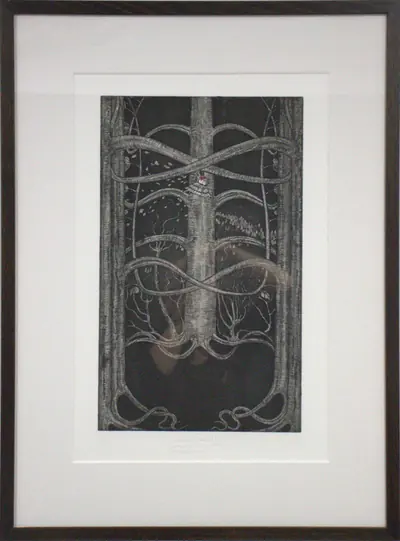
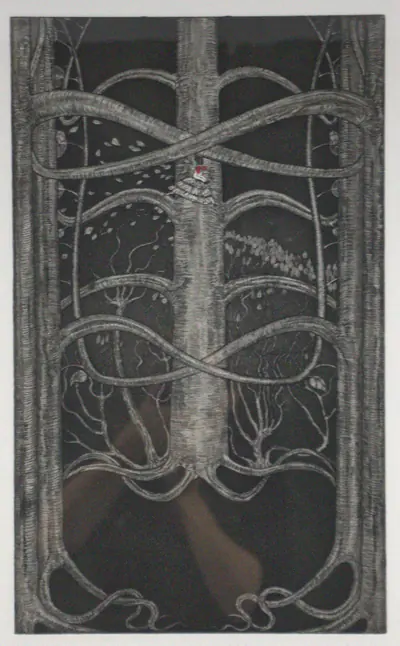
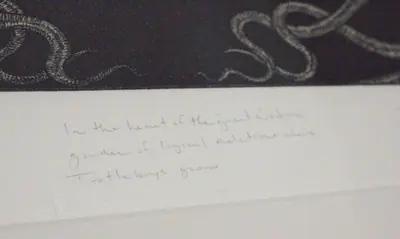
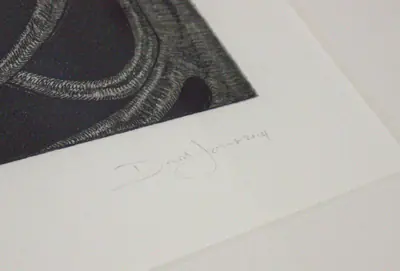
In the Heart of the Great Western Garden of Logical Relations Where Turtle Boys Grow
Dr. David Jones
The Work
This etching, titled In the Heart of the Great Western Garden of Logical Relations Where Turtle Boys Grow, comes from David Jones's exhibition Turtleboy and Puppet's Cabinet of Curiosity. The exhibition repositions Turtleboy and Puppet — small souvenir objects from a racially prejudiced past — as metaphors within a postcolonial critique, using melancholic humour to prompt reflection on racism's continuation within Australian society. In this piece, a tree rises through the frame with branches looping into repeated infinity forms, and Turtle Boy is shown nestled within the branches, picked out in red against the otherwise monochrome, densely crosshatched linework.
- Year
- 2000
- Medium
- Etching
- Image size
- 295 mm x 490 mm
- Framed size
- 580 mm x 785 mm
- Catalogue
- 0020
Provenance
I purchased this piece directly from the Wollongabba Art Gallery during David Jones' exhibition, which featured works from his Turtleboy project. I have always been drawn to his printmaking, and this etching captured my attention immediately for its intricate detail and the provocative concept behind the work.
Ask about the price, make an offer, or simply ask a question — payment is arranged directly (bank transfer, PayID, or cash).